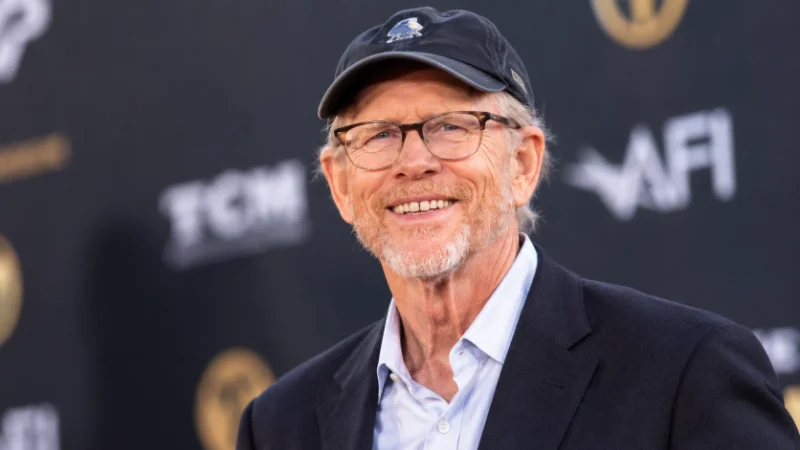
Ron Howard’s net worth is estimated at $200 million, according to Celebrity Net Worth. That figure reflects six decades of work as a child actor, television star, and eventually one of Hollywood’s most consistently working directors and producers.
Quick Facts
| Category | Detail |
| Full Name | Ronald William Howard |
| Born | March 1, 1954, Duncan, Oklahoma |
| Net Worth | Approximately $200 million |
| Profession | Director, producer, actor |
| Primary Income Source | Directing fees, producing, Imagine Entertainment |
| Average Annual Income | Around $30 million |
Early Life and Background
Howard was born to Rance and Jean Howard, both working actors who moved the family to Hollywood when he was a toddler. He started appearing on screen before he could read, landing a role in the 1955 film “Frontier Woman” as a small child. He was on a laundry detergent commercial at eighteen months old, which is about as early a start as a career in entertainment can have.
His break came at age six, when he was cast as Opie Taylor on “The Andy Griffith Show.” The series ran from 1960 to 1968 and turned Howard into one of the most recognized child performers on American television. Unlike many child actors, he had parents already working in the industry, which meant contracts, scheduling, and money were handled by people who understood the business rather than being figured out on the fly.
That early, steady income, paired with parents who understood the entertainment business from the inside, gave Howard a financial and professional head start most child actors never get. It also set the direction his career would take for the next fifteen years, and it gave him something arguably more valuable than the paychecks themselves: a working knowledge of how a set runs, learned from the inside, years before he ever sat in a director’s chair.
Career and Income Breakdown
From Child Star to Teen Icon
After “The Andy Griffith Show” ended, Howard kept working steadily through his teenage years, appearing in “The Music Man” (1962) and “American Graffiti” (1973). Then came Richie Cunningham on “Happy Days,” a role he played from 1974 to 1980 that made him a household name for a second time, with a different generation of viewers.

Howard walked away from acting in 1980, at the height of his fame on “Happy Days,” to move behind the camera. That decision is the real hinge point in his financial story. Acting paychecks, even from a hit show, have a ceiling. Directing and owning a piece of the projects he made did not.
Building a Directing Career
Howard’s early directing work included comedies like “Night Shift” (1982) and “Splash” (1984), the latter a commercial hit that established him as a director who could deliver at the box office. From there, his filmography grew to include “Apollo 13” (1995), “Cinderella Man” (2005), “The Da Vinci Code” (2006), and “Frost/Nixon” (2008), a run that put him in steady demand across genres, from prestige drama to big-budget thriller.
His biggest professional and financial turning point came with “A Beautiful Mind” (2001), which won the Academy Award for Best Picture and earned Howard the Academy Award for Best Director. Across his career, Howard has won two Academy Awards, roughly eight Emmy Awards, two Golden Globes, and two Grammy Awards, along with the National Medal of Arts in 2003 and two stars on the Hollywood Walk of Fame. That kind of track record is part of why studios keep bringing him big-budget material, from historical dramas to true-story thrillers like “Thirteen Lives,” decades into his directing career.
Directing fees at Howard’s level are not public record for any single project, but industry reporting on comparable A-list directors, cited by outlets like Celebrity Net Worth, puts his base fee in the range of $10 million to $20 million per film before backend bonuses tied to box office performance. On a film that performs well, that backend is often where the real money sits, and it is a large part of why a director’s income can vary so much from one year to the next depending on what is in theaters.
Imagine Entertainment and Producing
In 1986, Howard co-founded Imagine Entertainment with Brian Grazer. [internal link opportunity: related article on Imagine Entertainment’s biggest productions] The company has produced or executive produced dozens of films and television projects over the decades, giving Howard an ownership stake and a producing income stream separate from his directing fees.
That structure matters for a wealth estimate. A director who only directs earns per project. A director who also owns the production company behind those projects, and behind other people’s projects too, earns from a wider base. Imagine’s slate has included documentaries, scripted series, and awards contenders, spreading Howard’s income across formats rather than tying it to any single box office result.

Howard has stayed active into his seventies rather than slowing down. Recent directing and producing credits include the documentary “Jim Henson Idea Man” (2024) and the survival thriller “Eden” (2024, released theatrically in 2025). He is currently attached to direct “Alone at Dawn” for Amazon MGM Studios, a military drama starring Adam Driver and Anne Hathaway, under Imagine Entertainment’s first-look deal with the studio. On the production side, Imagine has kept a full slate of television and documentary projects moving through outlets including Disney+ and Amazon, with Howard credited as executive producer on several 2025 and 2026 releases, including the docuseries “Barbara Walters: Tell Me Everything” and the sports documentary “Earnhardt.”
How Ron Howard’s Net Worth Compares to Other Directors
Placed next to some of his peers, Howard’s $200 million looks modest. Steven Spielberg’s net worth is estimated at $7.1 billion by Forbes, built largely from directing fees on the highest-grossing films ever made, backend profit participation, and a long-running revenue share tied to Universal Studios theme park attractions.
The gap comes down to a different business model rather than a difference in output or acclaim. Spielberg co-founded a studio, DreamWorks, and holds ownership stakes tied to intellectual property that keeps generating revenue decades after release. Howard’s wealth, by contrast, comes almost entirely from working income: directing fees, producing revenue through Imagine Entertainment, and occasional acting work, without a studio-level ownership stake or a franchise that pays out on its own.

That distinction is common among working directors. A $200 million net worth built from consistent, decades-long output as a director, producer, and occasional actor places Howard solidly among Hollywood’s most financially successful career filmmakers, even if it is not in the same tier as a small number of director-founders who also built or co-founded studios.
Income Sources
Howard’s income today comes from a mix of sources rather than one paycheck. Directing fees and backend bonuses from feature films remain a core piece. Producing revenue through Imagine Entertainment, both from his own projects and others the company backs, adds a second layer.
He also earns from occasional acting and voice work. Howard rarely takes on-screen roles anymore, but he has made select appearances in recent years, including a cameo in the Apple TV+ series “The Studio” in 2025. Beyond film and television, Howard has authored books and hosted audio projects tied to Imagine’s expanding documentary and podcast slate, which contribute smaller but steady income streams on top of his film work.
Executive producing credits add a fourth layer that is easy to overlook. Howard’s name attached to a project, even one he did not direct, carries enough weight with buyers and audiences that Imagine can attach him as an executive producer across a wide range of television series, documentaries, and specials, each contributing a smaller fee on top of the larger paychecks from his directing work.
Notable Assets
Howard has kept a relatively low public profile compared to many entertainers of his wealth level. Detailed, independently verified information about specific real estate holdings or other major assets is not widely available in named, checkable sources, so this piece does not speculate on individual properties or purchases. What is well documented is the scale and consistency of his working career, which is the actual driver behind the $200 million figure most outlets cite.
That consistency is worth sitting with for a moment. Howard has been working in the entertainment industry for close to seventy years, first in front of the camera and then behind it. Few people in Hollywood have matched that combination of longevity and reinvention, and it shows in how steadily his estimated net worth has climbed compared to performers whose income depended on a single hit show or franchise.